DOC BEST: a European Project to Transform Doctoral Education
Doctorate Challenge Based Education for Sustainable Transformation
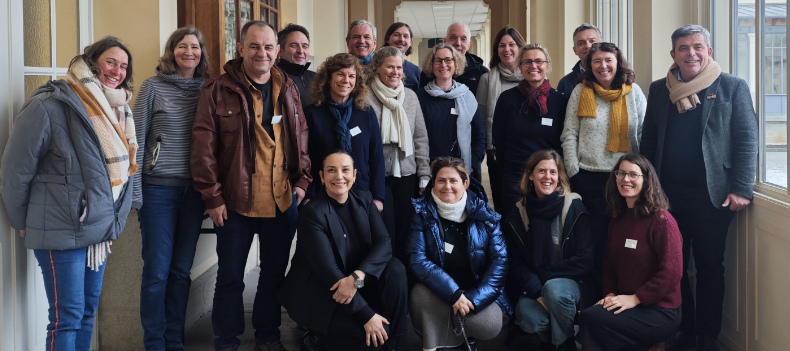
On 7 and 8 January 2026, Institut Agro hosted the kick-off meeting of DOC BEST (Doctorate Challenge Based Education for Sustainable Transformation), a major European initiative marking a turning point for ELLS (Euroleague of Life Sciences Universities).
For the first time, eight universities from the alliance have joined forces around a shared ambition focused on doctoral education.
Training tomorrow’s scientists to address major transitions
In the face of the complex challenges posed by agricultural and environmental transitions, the need to train researchers capable of working beyond disciplinary and national boundaries has never been more pressing. This is precisely the aim of DOC BEST, a project funded by Erasmus+ with a budget of €400,000, running until November 2028.
“Despite the excellence of European research, (very: enlever) few of our doctoral candidates benefit from European-level international joint supervision,” explains Marilyne Huchet, in charge of the PhD program at Institut Agro, and project coordinator with Marie-Stéphane Tixier . DOC BEST will remove administrative barriers and create the conditions for genuine European cooperation in doctoral education.”
A network of eight European universities
This mobilisation of eight universities around doctoral education is a first for the ELLS Universities alliance. The consortium represents nearly 6,500 doctoral candidates in the fields of agriculture, food and the environment and brings together:
- L'Institut Agro – Project coordinator
- Wageningen University (Netherlands)
- Universität Hohenheim (Germany)
- Universität für Bodenkultur Wien (Austria)
- Norwegian University of Life Sciences (Norway)
- Universitat de Lleida (Spain)
- Warsaw University of Life Sciences (Poland)
- Università degli Studi della Tuscia (Italy)
This unprecedented level of cooperation within the ELLS alliance reflects a clear academic and political choice: to invest collectively in doctoral education and make it a cornerstone of European integration among our institutions.
By placing doctoral education at the heart of our societal responsibility, DOC BEST aims to train the researchers Europe needs to meet the challenges of the 21st century. Fully aligned with European priorities on the environment and climate change, the project directly contributes to the Sustainable Development Goals, particularly food security, climate action and the protection of terrestrial ecosystems.
Three key ambitions
-
Facilitating European joint doctoral supervision
The project will begin with a review of doctoral programmes and systems across the eight universities to identify existing frameworks for joint doctorates, pinpoint administrative and legal barriers, and highlight good practices. This analysis will lead to concrete recommendations to facilitate joint doctoral supervision.
At a later stage, an online platform will allow partners to visualise available expertise and proposed PhD research topics across the alliance. -
Innovating through Challenge-Based Learning
At the heart of DOC BEST lies the Challenge-Based Learning (CBL) approach. This methodology places doctoral candidates in real, complex societal challenges that require knowledge from multiple disciplines.
Through this approach, doctoral candidates develop essential transversal skills: interdisciplinary and intercultural teamwork, open-mindedness, creativity, project management, adaptability and dialogue with society.
Several sessions bringing together doctoral candidates from the eight partner institutions are already planned in the Netherlands, Austria and France, in collaboration with researchers and socio-economic stakeholders.
Beyond its societal impact—more relevant research, better uptake by stakeholders and more innovative, applicable solutions—this approach also increases doctoral candidates’ engagement, strengthens their confidence and helps reduce the isolation often experienced during doctoral studies. -
Co-constructing with socio-economic stakeholders
From the outset, DOC BEST involves industrial, agricultural and institutional partners to identify the doctoral research topics Europe will need tomorrow.
A foundational project for the future of ELLS Universities
While DOC BEST formally involves eight partner universities, its ambition is deliberately broader. The knowledge, tools and frameworks developed through the project are intended to benefit the entire ELLS alliance, creating shared standards and a common dynamic in doctoral education.
DOC BEST should be seen as a foundation for what comes next, emphasised Romain Jeantet, Director of Institut Agro Rennes-Angers, at the opening of the meeting.
As a living lab, a proof of concept and a catalyst, this project demonstrates how doctoral education can become a unifying force for the ELLS Universities alliance and a cornerstone of our future European university.
First milestones set at the kick-off meeting
The two-day launch meeting in Rennes enabled project teams to:
- Clearly define roles and responsibilities across the four work packages:
- Management and coordination
- Development of a framework for transdisciplinary doctoral programmes
- Development of a pedagogical framework to strengthen doctoral candidates’ skills in addressing agri-food and environmental challenges
- Connecting transdisciplinary doctoral studies with society
- Establish a detailed project timeline
- Set up collaboration tools
- Prepare the survey on current Challenge-Based Learning practices
The first results are expected in 2026, with the outcomes of the comparative analysis of doctoral programmes across the partner institutions.